The single most important rule: apply before you demo
Almost every turf replacement rebate program in the region — whether administered through the Metropolitan Water District's SoCal Water$mart program, the San Diego County Water Authority, or your individual retail water agency — requires that you submit an application and receive approval before any grass is removed.
Homeowners lose rebate eligibility this way constantly. The crew shows up, the lawn comes out on day one, and the application filed the following week gets denied because there is no verifiable 'before' condition. If a rebate is part of your budget, the application goes in first and demolition waits for the approval letter.
Who administers rebates in San Diego County
There is no single San Diego rebate. Programs stack and vary by the retail agency that bills you for water, which is why two neighbors on opposite sides of a boundary can qualify for different amounts.
Check your water bill for the agency name, then look up that agency's current landscape rebate page. Regional base incentives are sometimes supplemented by your local agency, which is where the higher per-square-foot numbers come from.
| Area | Water agency |
|---|---|
| San Diego, La Jolla, Point Loma, Clairemont, Carmel Valley, Scripps Ranch | City of San Diego Public Utilities |
| Del Mar, Encinitas, Cardiff | San Dieguito Water District |
| Olivenhain, parts of Encinitas and Rancho Santa Fe | Olivenhain Municipal Water District |
| Rancho Santa Fe, Solana Beach | Santa Fe Irrigation District |
| La Mesa, El Cajon, Lemon Grove | Helix Water District |
| Santee, east El Cajon | Padre Dam Municipal Water District |
| Chula Vista (west), National City | Sweetwater Authority |
| Chula Vista (east), Otay Ranch, Eastlake | Otay Water District |
| Poway | City of Poway |
| Coronado | California American Water |
What typically qualifies
Programs are written to reduce outdoor potable water use permanently. The specifics change, but the structure of the requirements has been remarkably consistent across program years.
- Living grass being removed — dead, dormant or already-bare areas usually do not count
- A minimum converted area, commonly a few hundred square feet
- Plant coverage requirements at maturity, frequently around three plants per 100 square feet with a coverage target
- Conversion of overhead spray to drip, or capping the irrigation entirely
- Permeable surfaces — the converted area must absorb rainfall rather than shed it to the street
- Photo documentation before, during and after, plus a post-installation inspection
What disqualifies projects
This is the part worth reading twice, because these are the reasons real applications get rejected after the work is done.
- Artificial turf. Most regional programs specifically exclude synthetic turf as the replacement surface.
- Impermeable hardscape. Replacing lawn with poured concrete generally disqualifies that area.
- Bare mulch with no plants. Mulch alone rarely meets the plant coverage requirement.
- Removing grass before approval, as covered above.
- Leaving overhead spray heads irrigating the converted zone.
How we design a yard that passes
The tension in most projects is between the rebate rules and what the homeowner actually wants — usually some usable hard surface and some low-maintenance ground. Both are achievable if you zone the yard deliberately.
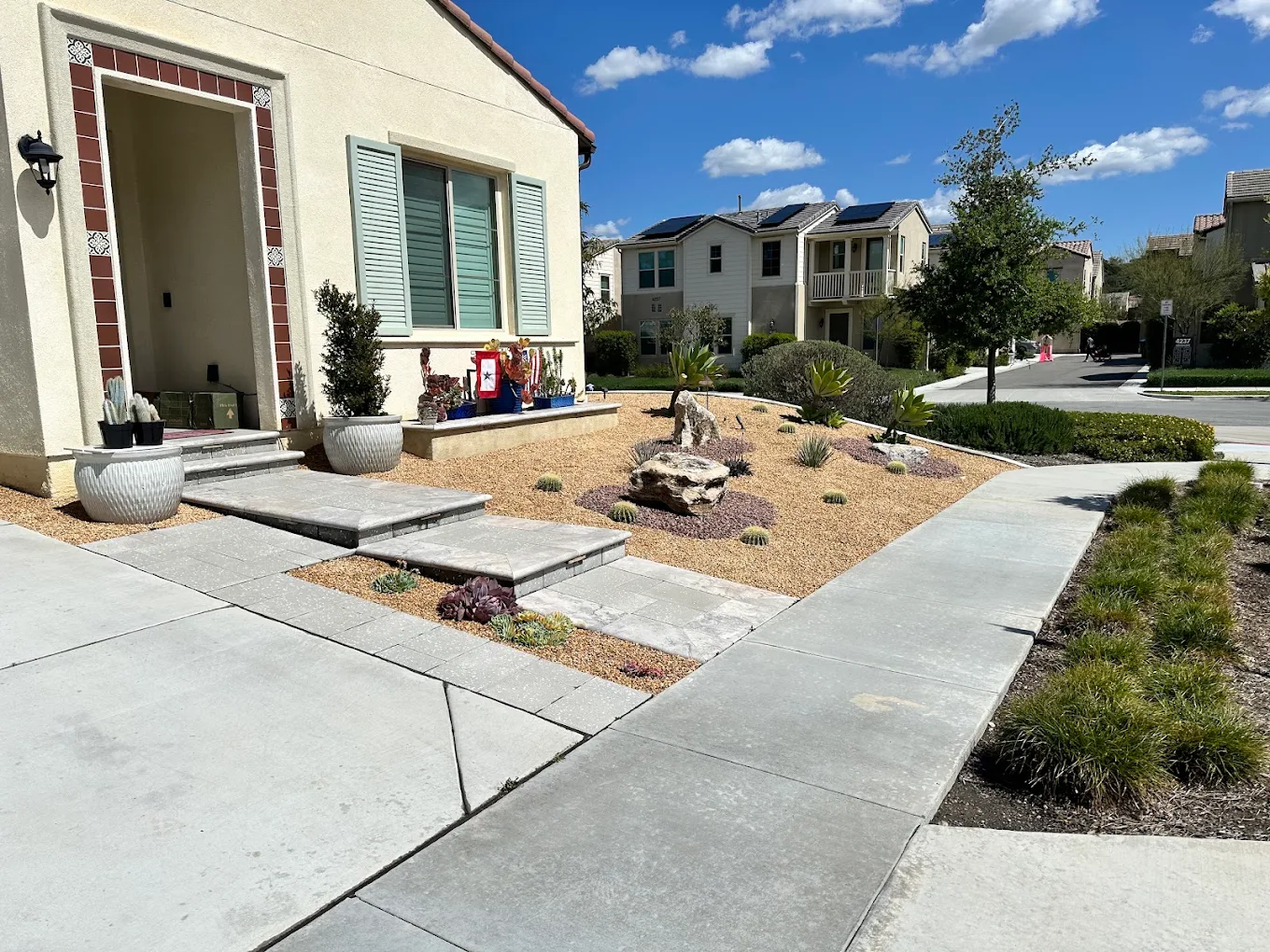
We separate the property into a rebate-eligible conversion zone and a non-rebate zone. The conversion zone gets a dense, drip-irrigated, water-wise plant palette that comfortably exceeds coverage requirements. Patios, walkways and any synthetic turf sit outside that boundary and are simply excluded from the claimed square footage.
Permeable pavers deserve a specific mention: because they infiltrate rather than shed water, they often sit far more comfortably inside a rebate-conscious design than poured concrete does. Confirm treatment with your agency before you count the square footage.
Beyond turf: other incentives worth checking
Rain barrel and cistern rebates, smart irrigation controller rebates, and rotating spray nozzle incentives all appear regularly in regional and retail agency programs. Individually they are small; on a full landscape renovation they add up to a meaningful offset.
If you are doing a whole-yard project, it is worth spending an hour on your agency's rebate page before design is finalized. A few plan adjustments made early cost nothing and can materially change what you get back.
Realistic timeline
Plan on several weeks between application and approval, then the build, then a post-installation inspection and a further wait for the check. Rebate money is a reimbursement, not a discount — you fund the project and recover part of the cost afterward.
For most homeowners the practical takeaway is this: design the yard you want, check the rebate rules before demolition, and treat any rebate as a bonus rather than as project financing.
Common questions
- Does artificial turf qualify for a San Diego water rebate?
- Generally no. Regional turf replacement programs are designed around living, low-water plant conversions and typically exclude synthetic turf as the replacement surface. Artificial turf still saves water and maintenance — it just is not usually the path to a rebate check.
- Can I remove my lawn before applying?
- No. Nearly every program requires pre-approval with photo documentation of the existing living grass. Removing it first is the most common reason applications are denied.
- Do permeable pavers count toward the converted area?
- Often yes, because they infiltrate rainfall, while poured concrete typically does not. Confirm the current treatment with your specific water agency before finalizing the plan.
- Which water agency do I apply through?
- The one that bills you. Check your water bill, then visit that agency's landscape rebate page — regional incentives are often supplemented locally, which is why amounts vary across neighborhoods.
Related services
- Landscape Planting & Garden Design in San Diego
- Irrigation & Landscape Drainage in San Diego
- Artificial Turf Installation in San Diego
Licensed C-27 Landscape Contractor — CSLB #1159370